It is eye-opening to discover how much patients are not actually seen or understood in their stay in the Hospital. People are focused on their work, so in retrospect it makes sense. But if you stand outside of any particular job and just watch a patient for a couple of hours in the Emergency Department, or on an Inpatient Unit, or in a Clinic or Same-Day Surgery you will discover many things. Some very positive and affirming: people are healing patients all the time. And some of those things will be negative - opportunities for improvement.
When an executive spends the time to do observational work they are saying to the entire organization "It's better to open our eyes, even though we will discover some things aren't working, then to close our eyes and say conveniently, but untruthfully, 'mission accomplished'".
This chart is a simple method of illustrating a patient's experience during a period of two or three hours in any location in the Hospital. In the particular example here, this is a patient's three-hour stay in an Emergency Department. Each slice of color represents a period of time. The color coding is described at the bottom from left to right in the order in which it occurred. You can click on the chart for a larger full-size version easier to read or to print.
The patient walked in the door at nine AM. Without any delay at all, they were Triaged and registered. The Triage process was very fast, but the registration process took a little time.
The patient was taken to a room in back immediately after their registration (green) and began waiting in their treatment room. This first waiting period is illustrated as the first red block to the far left. Throughout the chart all patient waiting time is shown as red.
This patient had stomach pains, and did not require admission to the hospital. Most emergency departments would view a three hour length of stay as great. And in many ways it is. But not necessarily for an outpatient. 90 minutes is good for the outpatient.
There are several stages of work involved. Note the MD assessment in yellow. That actually took place in the last third of the visit. The patient spent nearly two-thirds of their visit just waiting. During that waiting time some work occurred - lab orders, MD / RN reviews and communication, phone calls, gathering materials / medications, etc.... However, the patient sat for just over an hour without anyone entering their room to keep them informed. From their perspective, this was all just waiting delay. This was during a very tense time for the patient, so that hour could well have been an eternity.
And much of that red time was delay for the staff as well: items waiting to be attended to, or not available when needed, etc....
We interviewed the patient at the close of their stay. They were very appreciative, but did mention that the delay was not a positive experience for them. They were worried and were unsure how serious their symptoms were. They became even more anxious, thinking the medical staff were trying to figure out what was wrong, and that maybe no one really knew. And no one could tell them until just near the very end of the stay, almost two hours into their visit.
As mentioned above, three hours is not long for an inpatient ED admission, but it is long for an outpatient. If you are in pain or worried, without proper care, teaching, attention, ten minutes can be a lifetime in hell. And nearly two hours waiting in back is not ideal care.
Here was a hospital that had already gone through a major lean initiative, and another Patient Satisfaction / Management Coaching initiative to 'hard-wire' improvement. The commitment to excellence was well established, so we heard.
These programs taught "continuous improvment" in their words. But in their structure of a single phase of discrete one-time process and management changes, they were actually teaching "one-time fix" behaviors.
Any interest at all in going back to observe patients or the flow again was the last thing on most folks' minds. They had been "improved" and didn't want to go back there. For them, continuous improvement was really a sign of failure.
Their words were "We believe in Continuous Improvement" but their actions were "We're already done with that. We won't be going back there again. Why would we?"
How well did these other improvement programs serve the hospital, if the culture, at the close of the project, was a culture of "we're done" "we're excellent enough" "we don't need to nor want to look anymore at that?" "Patient care? Mission Accomplished!"
Yet, the job was not done. The consultants were done, but the job wasn't really done, and certainly not 'hard-wired'.
Indeed, the notion of ''hard-wired' or 'made to last' speaks to the idea of the turn-key operation: That it can be done once and for all, like buying a new car. But according to Tom Peters in Re-Imagine! this thinking is wrong: really exceptional performance must be built and re-built every day with great care and creativity, and no one can proscribe exactly how it must look. Vigilance and observation do not end. They become part of everyone's personal practice, personal approach to seeking feedback; seeking to stay close to the patient's experience. And they use that constant flow of new information personally gathered to discuss, to brainstorm as they work, in the department, in real-time.
Peter Drucker wrote about this over fifty years ago in The Practice of Management. By the time performance metrics are quantified into a nice report, they are obsolete. They can only confirm that you have managed well, but cannot guide you. For that, you must gather your own handful of information every day directly, and that in collaboration with the people you work with.
You cannot "hard-wire" living systems, and if you really try to, it becomes a barrier, an impediment to true excellence. That is why nobody wanted to look again. They thought it was now "hard-wired". However, because excellence is a flow of energy, ideas, teamwork and creativity, a process of self-examination and observation, a human process of collaboration and change, a living process, it cannot be nailed down into something fixed, or done, so that others feel it is "mission accomplished" and can turn away to other things.
There is something uncomfortably open-ended about real excellence. But many thrive on the adventure.
"Systems" become obsolete very quickly in a truly exceptional operation. New methods and philosophies are developed all the time because no matter how good it was, people want to do better. It is a 'hard wired' realization to see that there is no standing still. You cannot maintain. You can move forward, and if not, the hospital slips backward.
"Maintaining" the number one position requires continuous effort. It doesn't end. It must be made, constructed, built every day again. And that is because in a Hospital, excellence is care, and care is human performance.
It won't look the same every day, or for every patient. To reach and live a core set of values means, paradoxically, not doing it the same way. Customization, adjusting for the patient. Listening. It is always new. That is the difference between life and death to an organization or a human being.
Rather than "hard-wire" why not think about "liberation" of the organization? Rather than think of the Hospital as some giant machine, why not think of it as a living entity always poised to take the next step in personal growth? Why not?
But a living being needs nurturing and feeding, and sometimes they don't turn out just as you might like.
Innovation is far more powerful than any machine.
Nowhere is this distinction between living in the flow of excellence and living in a retrospective hard-wired "system" most in evidence than with 'rounding'. When we have watched folks "round" after having earned a "black belt" in rounding, we see they are hitting the points on their checklist, but missing obvious things staring them in the face. They talk to the patient but stop noticing that the nurse hasn't washed her or his hands or used the hand sanitizer. They ask the patient questions, but do not stop to watch a nurse and a patient interact with each other, nor to give good praise or feedback when such interactions happen to take place in front of them. They don't ask the nurse "How are YOU doing today? How is the work flow for you?" They don't stop and brainstorm for a solution right there. And many a tired nurse has been simply overlooked by the exec doing rounding. They are trying to get through their "rounding" responsibilities. And that is what they are doing - going through the motions. But they aren't actually rounding.
Try telling an Olympic Athlete that your training exercises to help them swim, or run, or jump are so good they will not actually need to swim, jump, or run again! That is the chimera of "lean" and "hard-wiring" promises. Once you "hard-wire" anything, people stop thinking about what they should be doing; people stop looking around to see what is going on; people rely upon the "system" now because it has already been built, in the past tense; and so in the 'present tense' they just go through the motions of that "system" just like they did the last system. No Olympic Athlete could get away with that.
Showing posts with label patient flow. Show all posts
Monday, March 21, 2011
Monday, March 14, 2011
Emergency Department Door to Physician Treatment Under 30 Minutes ... NOW!
Door to MD / Door to Mid-level Treatment Time Simple Sampler
Statistics Shmatistics!
Got a watch? Can you count to ten? Like INSTANT results?
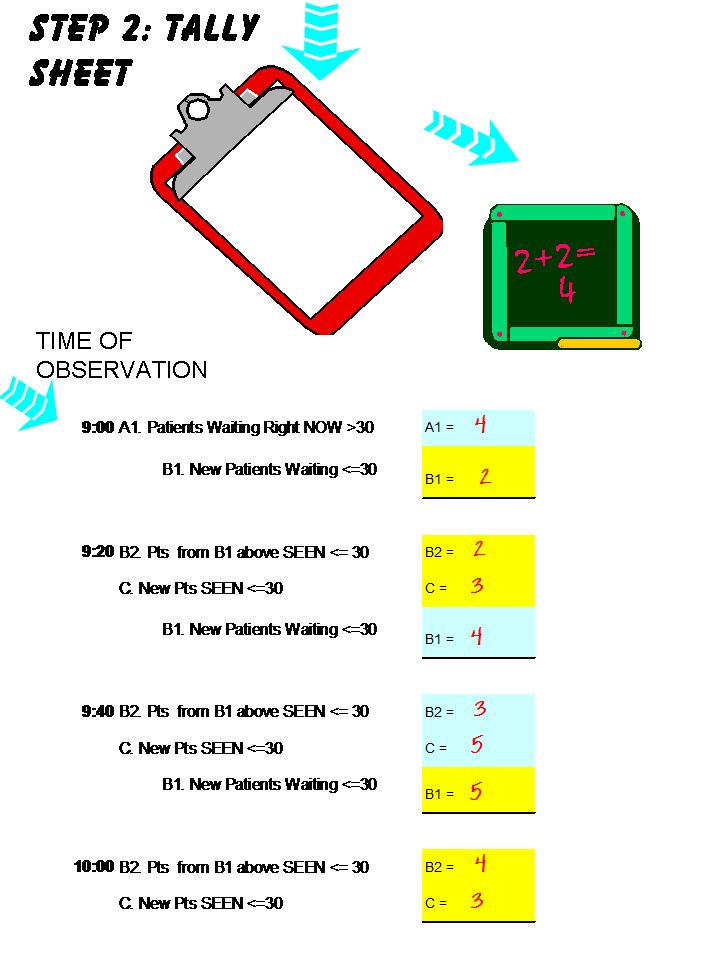
Want your Emergency Care Door-to-MD / Mid-level Treatment time down to BELOW 30 minutes RELIABLY, or your Urgent Care Door-to-MD/ Mid-level Treatment under 15 minutes?
Why measure it and "wait for the data" when you can
SEE IT!
TRACK IT!
and F I X I T !
at THE SAME TIME?
Such a deal!
POSTED EMERGENCY ROOM WAITING TIMES ARE OFTEN FAKE
We have seen a recent trend in Emergency Services and that is posting waiting times on billboards, or the Hospital's internet front page that are very short - 20 minutes, 15 minutes, 10 minutes.
When we dig into the data, we find that the traditional standard measure of Door to Treatment (that includes Patient entrance into the waiting area, greeting, registration, triage [in Waiting Area or at bedside], Caregiver Assessment/Teaching, initial lab draws, MD / Mid-level reviews chart and then MD / Mid-level enters room, assesses and begins Treatment) is not actually being used. A new measure has been created. The traditional measure was called Door to MD / Mid-Level Treatment.
And the new measure is called "Waiting Time to Being Seen": But not necessarily seen by the MD or Mid-Level. Sometimes it is "waiting time to be seen" by a greeter or clerk. When it is an MD, Mid-Level or RN, it is not necessarily "waiting time to be seen" for actual Triage and Clinical Assessment; often it is nothing more than "being seen" by an RN, Mid-Level or MD passing through the waiting area, or initially greeting the patient at the front desk. No actual history, assessment or anything that could legitimately qualify as clinical work is being done at that point where this "waiting time" is proclaimed as over.
The actual formal clinical Triage assessment is still later in the process. And the additional waiting time to get there is now hidden from the claimed metric for "waiting time".
Furthermore the "waiting to be seen" metric doesn't always begin at the door. Originally, the "Door to MD / Mid-Level Treatment Begins" started when the patient first entered the door of the waiting area or the Emergency Trauma entrance of the Hospital.
The new metric doesn't start at the door. Now the starting point for this time measurement begins when the Registrar enters the patient's information into the computer, and that is generally when the patient is registered.
That happens after the patient has walked in the door, and after they have waited often at the end of a long line to speak to the registrar. Or simply waited for some time until a registrar or RN returned to the waiting area desk. Is this really the fair starting point for the patient's experience? No. The starting point is the moment they open the door and walk in or are rolled in.
A great deal of actual waiting time has been hidden from this highly touted new statistic, making it misleading.
But it makes the waiting time to RN, MD or Mid-level, indeed the entire Emergency Deparment Length of Stay look much better than it actually is!
Yes, metrics can be faked and often are.
These are all part of cutting corners on the metric to make the numbers look better because they are not actually part of making the flow more efficient for patients.
These times are not Door-to-MD / Mid-Level Treatment times according to the standardized, traditional metric.
DIRECT-TO-BED DONE WRONG MAKES THINGS WORSE
Some hospitals do bring patients directly to the bed in back when there is an empty and staffed bed, and this is a great strategy to reducing waiting time and potential medical error. But only so long as the RN completes the Triage work, initial labs, assessments and immediate interventions that are all part of the appropriate clinical pathway IMMEDIATELY when the patient is brought back. This expedites the MD /Mid-Level entering the room sooner to make their full assessment and begin formal intervention.
But Direct-to-Bed alone is not a fix and in isolation can make things worse, adding delay, neglect and medical error because, as we have seen, this can be used to warehouse a patient in the back where they are now isolated and still don't get rapid treatment.
Indeed, in some cases delays got longer, and clinical issues arose from those delays because the waiting room looked empty; the patient was now "out of sight - out of mind"; and no one really knew that the patient waiting in an Emergency Room bed in back hadn't yet been seen by RN, MD or Mid-level.
In fact, once they were placed into a bed in back, their actual status became a mystery - they fell into a crack in the process that looked on the tracking board like they were being assessed and treated, as though they had been seen by the RN but "seen" and "treated" are two different things - so the patient fell into a void, a twilight zone. On the tracking board, they were in a bed with an assigned nurse, maybe even seen by her or him so it looked like something was going on. But the RN assigned to that bed had not actually taken the assignment of that patient.
This is the problem with popular solutions that are not made in concert with actually changing the responsibilities, competencies, teamwork and communication points, but merely fixing the physical flow, or mechanically and mindlessly tracking data points in the computer.
The actual formal clinical Triage assessment is still later in the process. And the additional waiting time to get there is now hidden from the claimed metric for "waiting time".
Furthermore the "waiting to be seen" metric doesn't always begin at the door. Originally, the "Door to MD / Mid-Level Treatment Begins" started when the patient first entered the door of the waiting area or the Emergency Trauma entrance of the Hospital.
The new metric doesn't start at the door. Now the starting point for this time measurement begins when the Registrar enters the patient's information into the computer, and that is generally when the patient is registered.
That happens after the patient has walked in the door, and after they have waited often at the end of a long line to speak to the registrar. Or simply waited for some time until a registrar or RN returned to the waiting area desk. Is this really the fair starting point for the patient's experience? No. The starting point is the moment they open the door and walk in or are rolled in.
A great deal of actual waiting time has been hidden from this highly touted new statistic, making it misleading.
But it makes the waiting time to RN, MD or Mid-level, indeed the entire Emergency Deparment Length of Stay look much better than it actually is!
Yes, metrics can be faked and often are.
These are all part of cutting corners on the metric to make the numbers look better because they are not actually part of making the flow more efficient for patients.
These times are not Door-to-MD / Mid-Level Treatment times according to the standardized, traditional metric.
DIRECT-TO-BED DONE WRONG MAKES THINGS WORSE
Some hospitals do bring patients directly to the bed in back when there is an empty and staffed bed, and this is a great strategy to reducing waiting time and potential medical error. But only so long as the RN completes the Triage work, initial labs, assessments and immediate interventions that are all part of the appropriate clinical pathway IMMEDIATELY when the patient is brought back. This expedites the MD /Mid-Level entering the room sooner to make their full assessment and begin formal intervention.
But Direct-to-Bed alone is not a fix and in isolation can make things worse, adding delay, neglect and medical error because, as we have seen, this can be used to warehouse a patient in the back where they are now isolated and still don't get rapid treatment.
Indeed, in some cases delays got longer, and clinical issues arose from those delays because the waiting room looked empty; the patient was now "out of sight - out of mind"; and no one really knew that the patient waiting in an Emergency Room bed in back hadn't yet been seen by RN, MD or Mid-level.
In fact, once they were placed into a bed in back, their actual status became a mystery - they fell into a crack in the process that looked on the tracking board like they were being assessed and treated, as though they had been seen by the RN but "seen" and "treated" are two different things - so the patient fell into a void, a twilight zone. On the tracking board, they were in a bed with an assigned nurse, maybe even seen by her or him so it looked like something was going on. But the RN assigned to that bed had not actually taken the assignment of that patient.
This is the problem with popular solutions that are not made in concert with actually changing the responsibilities, competencies, teamwork and communication points, but merely fixing the physical flow, or mechanically and mindlessly tracking data points in the computer.
Rather than fix the actual problems, some Hospitals have found a way to dissimulate (nice word for fibbing or misleading) by cutting corners on what they actually report as "waiting time". They compromise the original intention of waiting time: How long does the patient have to wait before their treatment begins? Door To Treatment!
In our discussion today, we aren't talking about the fake "Waiting Time in Our Emergency Department waiting Room" metric that some hospitals brag about and even post on bill boards and on the internet.
We are here talking about the real thing: The time from when the patient opens the door to enter the building to the time the MD or Mid-Level begins treatment.
And that time can be and is well under 30 minutes in the top performing hospitals - even in complex Trauma Centers that are also university teaching hospitals - such as Duke University Hospital - a shining example of this level of performance.
How can you take that next step in the journey of your own Emergency Department?
You can learn from the stuff we did with Duke and other Number One Hospitals:
We are here talking about the real thing: The time from when the patient opens the door to enter the building to the time the MD or Mid-Level begins treatment.
And that time can be and is well under 30 minutes in the top performing hospitals - even in complex Trauma Centers that are also university teaching hospitals - such as Duke University Hospital - a shining example of this level of performance.
How can you take that next step in the journey of your own Emergency Department?
You can learn from the stuff we did with Duke and other Number One Hospitals:
SEE THE FLOW - BE THE FLOW
Subscribe to:
Posts (Atom)